


If you’re shopping around for a new office chair (or chairs), then you’ve probably spotted that there’s a huge amount of options and features that you need to take into consideration when choosing one. If you want to ensure you select the perfect office chair for your needs, then read this comprehensive buying guide from the Rosehill team…
Office chair vs operator chair vs task chair: what’s the difference?
One of the first things you’re likely to notice when shopping for a new office chair is the fact that different retailers call them different names. These include:
- Office chair.
- Task chair.
- Operator chair.
The question you’re likely to have is; what’s the difference?
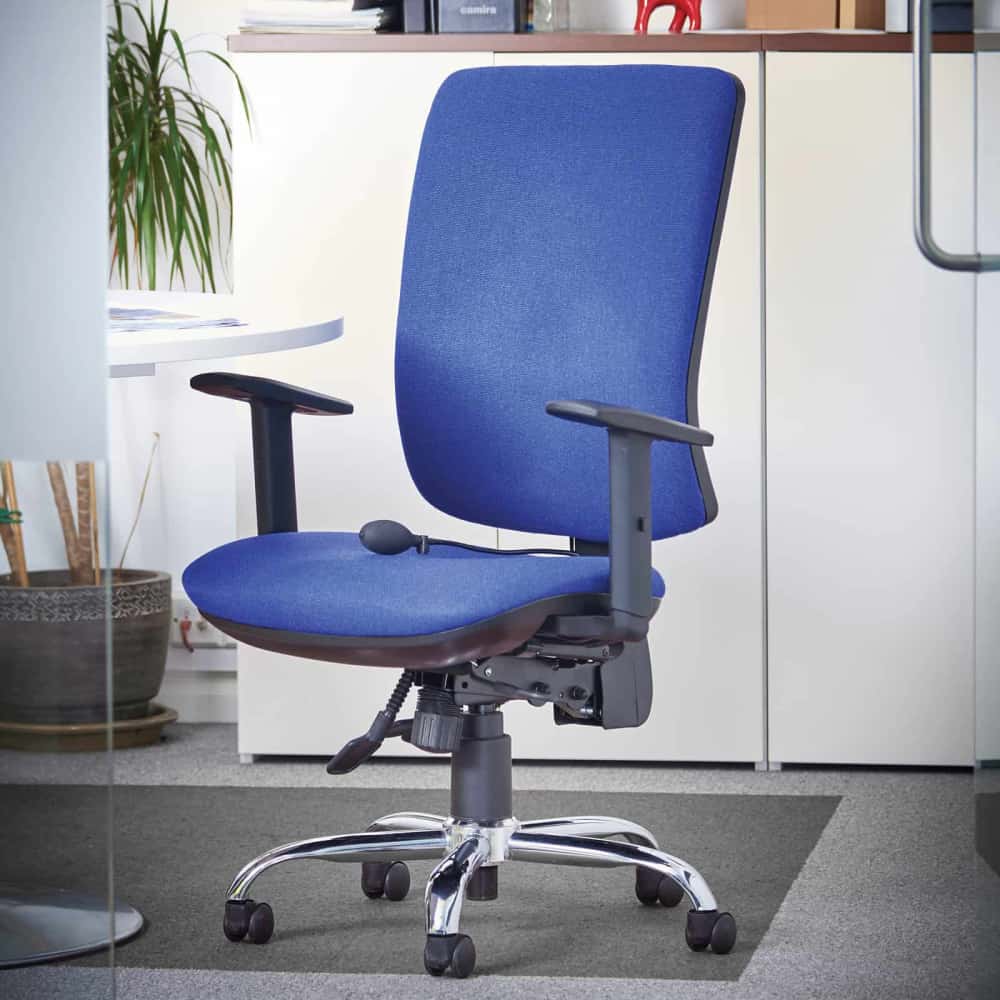
Here at Rosehill our answer is ‘none’! The terms office chair, task chair and operator chair are used interchangeable and refer to the same type of chair (see image below for example):

If you’ve ever worked in an office, then you’ll know what we’re referring to. Operator/task chairs are highly adjustable chairs that allow you to swivel around whilst remaining in a seated position. They will also typically feature adjustability, allowing you to change things like:
- The height of the chair.
- The angle of the chair’s back.
- The height and position of the chair’s arms (if it has any).
On premium office chairs, the level of available adjustability is immense, going far beyond those options bulleted above.
Like other types of chairs, task chairs – especially premium models – are available in a broad range of finishes, including different types and colours of upholstery, and different finishes/colours to the base.
In short, if you’re looking for a new set of chairs for your office, home office, or other setting, look for ‘office chairs’, ‘task chairs’, or ‘operator chairs’.
Note – we have covered the most commonly used names for office chairs above. However, you may even see these types of chairs referred to as stenographer chairs, steno chairs, or mesh office chairs.
Other types of task/operator chairs
At this point, we need to raise an important caveat. There are other types of chairs which are sometimes called task/operator chairs, but which don’t really fit into the traditional task chair mould.
For example, it’s possible to buy things like ‘draughtsman chairs’. These physically resemble task chairs, but are much higher, allowing the user to sit at taller tables or desks. Whilst draughtsman chairs are sometimes called office/task/operator chairs, they are a different and distinct type of chair, often for use in industrial settings.
It’s also possible to buy chairs that have ‘task bases’. As this implies, these are regular chairs which simply feature a task base. They allow the user to swivel – as on a task chair – but the upper section of the chair is fixed and is not adjustable. A good example of this is the Origin Lotus Task Chair, which features a task base, and a regular single poly chair section (as illustrated below):

These are popular for ICT rooms in schools and student accommodation bedrooms with study desks.
Why buying the correct type of office chair is important
When it comes to buying new office chairs, it may be tempting to just buy a model which sits at the most attractive price point.
However, we’d consider that to be a serious mistake.
Why?
Well, consider the following; in the UK, people spend more time sitting at their desk than they do sleeping in bed! (According to a study by YouGov, the average working day in the UK is eight hours, whilst the average time spent sleeping is seven hours).
With eight hours or more of the day being spent sitting in an office, it’s vital that you provide your employees with quality office chairs that are comfortable, prevent injury, and which support productivity.
It’s for this reason that the adjustability of an office chair is a particularly important feature to look for. With a proper range of adjustability, an office chair will provide appropriate support to a user’s back, legs and hips and reduce the risk of them developing musculoskeletal pain.
What are the benefits of quality office chairs?
As you’ve just read, office chairs of the appropriate quality can provide a wealth of benefits both to the people who use them, and the companies they work for. Below, we’ve provided more details about each of these benefits.
Good posture
Arguably the most significant benefit provided by good quality operator chairs is that they promote good posture.
When properly set up, they help the user keep their back straight, reducing weight on the user’s shoulders and ultimately reducing stress on the user’s muscles and joints.
Furthermore, if the task chair features armrests, these provide further support – particularly if the user spends a large portion of their day typing and/or using a computer mouse.
According to the Health and Safety Executive (HSE), over 30.8 million working days were lost to ‘work-related ill health’ over the 2021/22 period. In fact, as per a study conducted by Digby Brown Solicitors, approximately 600,000 workplace injuries recorded in the UK can be attributed to outdated and unsafe office furniture.
If you want to ensure your business isn’t adding to those numbers, then it’s certainly advisable to provide your employees with the best quality office chairs you can afford.
Improved productivity
Directly linked to the point above, good quality operator chairs will help to improve the productivity of your workers, ultimately contributing to your business’ bottom line.
Aside from the fact that quality office chairs reduce the likelihood of injury, they can also boost productivity in the following ways:
- Improved comfort – selecting chairs that are ergonomically designed and with features such as mesh backs, make your employees more comfortable, improving productivity.
- Improved communication – quality office chairs that allow the user to easily swivel and turn around will improve communication within your office space.
- Employee value – providing your employees with comfortable, well-specced and high-quality chairs will help them feel valued, thus boosting employee retention.
Longevity
Office chairs can be subject to significant wear and tear. Which is where one of the key benefits of quality task chairs comes into play.
By investing in premium office chairs for your office, you’ll end up with chairs that have significantly longer lifespans than budget equivalents. You’ll therefore end up spending less in the long run.
Versatile
As quality office chairs are highly adjustable, they are highly versatile items of furniture, being able to accommodate a wide range of users.
In other words, if you have people of different heights and weights regularly using your office space, task/operator chairs are the ideal choice as they can be adjusted to fit whoever needs to use them.
Office chair buying considerations
If you’ve decided that task chairs are the best option for your building/premises, then it’s time to start shopping.
However, as we mentioned at the outset of this article, you’ll be presented with a huge range of options and choices. To help you make the best choice, we’ve set out the key things you need to look for and think about when buying an office chair below.
Lead times
One of the most overlooked things when it comes to buying office chairs is lead times.
Ask yourself – do you need your office chairs in a hurry? Or are you able to wait?
Your answer to these questions is likely to influence your choice of office chair.
For example, if you are content to buy a fairly basic office chair (with limited features and colour choices), then you can have one delivered as quickly as the next working day (once your payment has cleared).
Should you want an office chair that is at the more premium end of the scale, then you should expect a slightly longer lead time (in some instances this can be between three and six weeks).
Why this disparity in lead times?
The answer is that cheaper office chairs are generally imported from manufacturers in the far east and are kept in stock, meaning they can be dispatched to you very quickly. As a result, however, you’ll have a very limited choice in terms of features, finishes and colours.
Premium office chairs are usually highly customisable and are thus made to order here in the UK or Europe. As a result, they have slightly longer lead times.
Which option is best for you is very much dependent on what you want from your office chairs. If you want your chairs to have particular features, colours and finishes, then you will need to factor in a longer lead time.
Cost
It’s inevitable that you’ll be working to a budget. However, it’s important to realise that when it comes to office chairs, your budget will have a big impact on what you can buy.
At the more budget end of things (where you’ll be paying approximately £130 exc. VAT), you’ll only have a limited choice of colours and finishes. Most importantly, you’ll find that cheaper office chairs have only basic adjustability.
At the other end of the scale, you can pay upwards of £500. But, for that kind of money, you’ll have a vast range of options to choose from and the ability to customise the chair to a great extent.
Adjustability and ergonomics
For most buyers, these are the two most important considerations when selecting and purchasing office chairs.
Adjustability and ergonomics are intrinsically linked, and a good-quality office chair will take both things into account as part of its design.
In order to select a chair which offers the right mix of adjustability and ergonomic comfort, you must first understand that the human body moves along three distinct planes:
- Frontal plane – also known as the coronal plane, this covers side-to-side movements.
- Sagittal plane – this refers to the right and left halves of your body and covers forward and backward movements.
- Transverse plane – this refers to the top and bottom halves of your body and covers twisting movements.
The ideal office chair will offer movement and flexibility across all three of these planes.
In order to accommodate this range of movement, an office chair should have (as a minimum), the following adjustability:
- Adjustable seat height – allowing the user to place their feet flat on the floor when seated in an upright position.
- Lower back support – the chair back should support the ‘lumbar’ region of the user’s spine. The user should be able to sit with their back against the back pad with their feet flat on the floor (the backs of their knees should not be touching the edge of the seat section).
- Seat shape – the actual seat of the office chair should be ergonomically shaped in order to provide comfort and support.
- Seat edge – ideally, the edge of the chair’s seat will be slightly rounded, such that it does not put undue pressure on the user’s legs.
As we say, these are the absolute minimum adjustments you should look for in an office chair.
However, as you look at operator chairs at the more premium end of the spectrum, you will begin to see more complex adjustment mechanisms that are (in many cases) unique to the manufacturer.
To provide you with a tangible example, consider NowyStyl – one of Europe’s leading manufacturers of premium office chairs. They have developed their unique X-MOVE system which allows their office chairs to dynamically move and adjust across the three planes of human movement.
Another important point to consider in terms of adjustability, is whether said adjustments are fixed or dynamic:
- Fixed – once the chair has been adjusted, it is fixed in a certain position.
- Dynamic – the chair is able to actively move and adjust as and when the user shifts their position when using the seat.
You’ll find that premium office chair adjustment mechanisms are dynamic, rather than fixed. This is because dynamic adjustment provides an extra level of support and ergonomic comfort that fixed adjustment mechanisms do not.
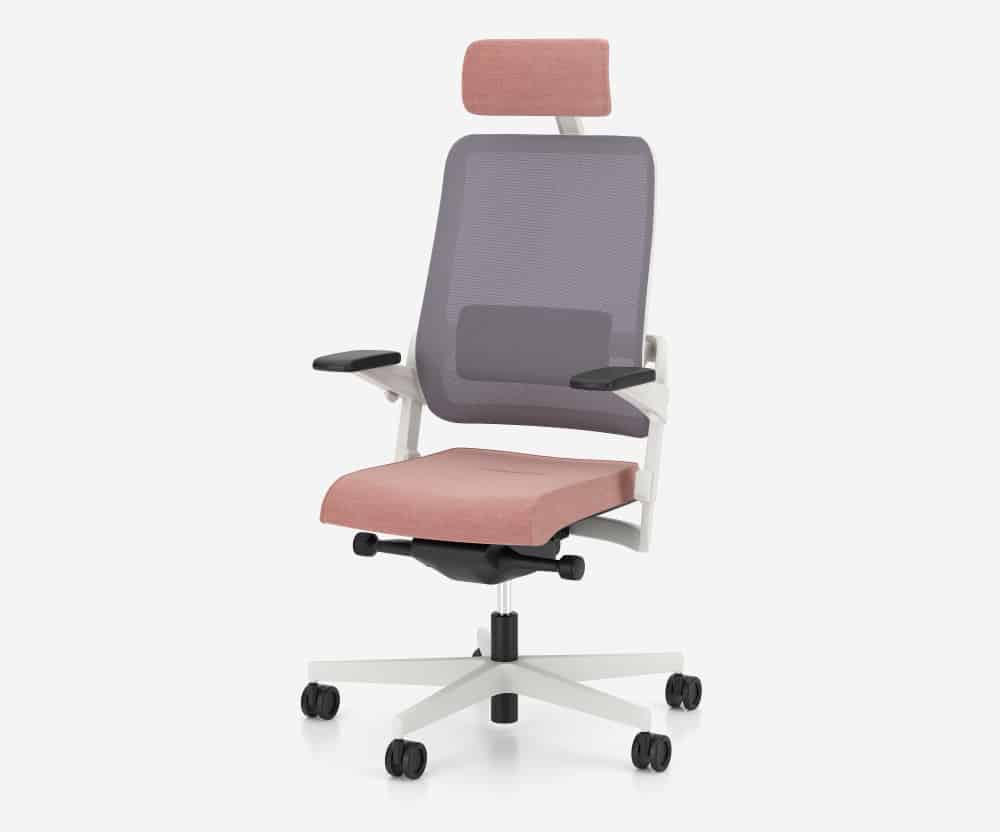
In short – if you’re looking for an office chair that offers maximal levels of support and comfort, choose one that features a well-designed and engineered dynamic adjustment mechanism. NowyStyl’s operator chairs are the perfect example of this type of chair.
Note – it’s important not to forget that personal preference plays an important role in how adjustable your office chairs need to be. Some people prefer more ‘fixed’ chairs, whilst others prefer ‘dynamic’ chairs. If in doubt, speak to your staff and see what they prefer.
Back height and head support
The next thing you’ll want to look at when choosing an office chair is its back height. Explore the UK market, and you’ll find that operator chairs are typically available with the following types of backs:
- Low back.
- Medium back.
- Medium back with a headrest.
- High-back/executive back.
The illustration below shows how each of these back types compares:
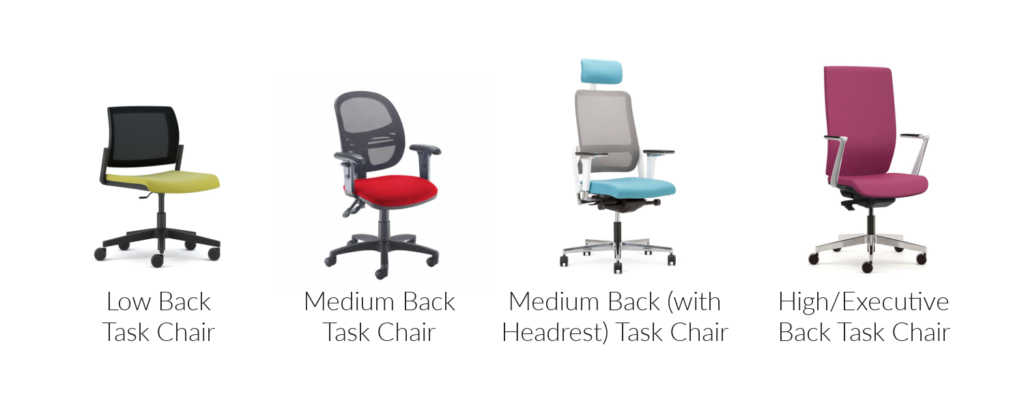
Which type of back is best for you and your employees is largely down to personal choice, however as a general rule, the higher the back, the more postural support is provided.
Note – you’ll typically find that a medium back chair with a headrest is about the same height as a high/executive back chair.
Materials
When it comes to office chairs, you’ll find that they all generally have metal bases and plastic or metal castor feet; there isn’t a huge variety in this area.
One area where you WILL find a great deal of variety is the materials used to upholster a chair’s seat and back pad.
When it comes to the seat, you can generally have it upholstered in fabric or faux leather. As for the back pad, depending on the model you choose you can have it upholstered in either fabric or faux leather. On some models, you can even select mesh backs or perforated backs – these are ideal if you tend to get warm whilst working and want more breathability from your chair.
Style and design
Closely related to the point above materials, you should give some thought as to how your chosen operator chairs fit in with the broader aesthetic and design of your space.
When it comes to office chair styles, it’s possible to buy everything from plush, faux-leather executive chairs that have a more traditional aesthetic, to superbly elegant, intricately designed office chairs that look like they could have rolled off an Apple production line.
The point here is this – when it comes to the design and style of your office chairs your choice is almost endless. If you require assistance selecting chairs that will complement your space, speak to the Rosehill team, and we’ll be happy to advise.
Bear in mind that it won’t just be your staff that sees your office chairs. For example, imagine you run a high-end law firm and regularly have clients coming to your office. If they’re presented with a bunch of tatty, cheap operator chairs, they’re likely to view your company in a less than favourable light. When it comes to task chairs, appearances matter!
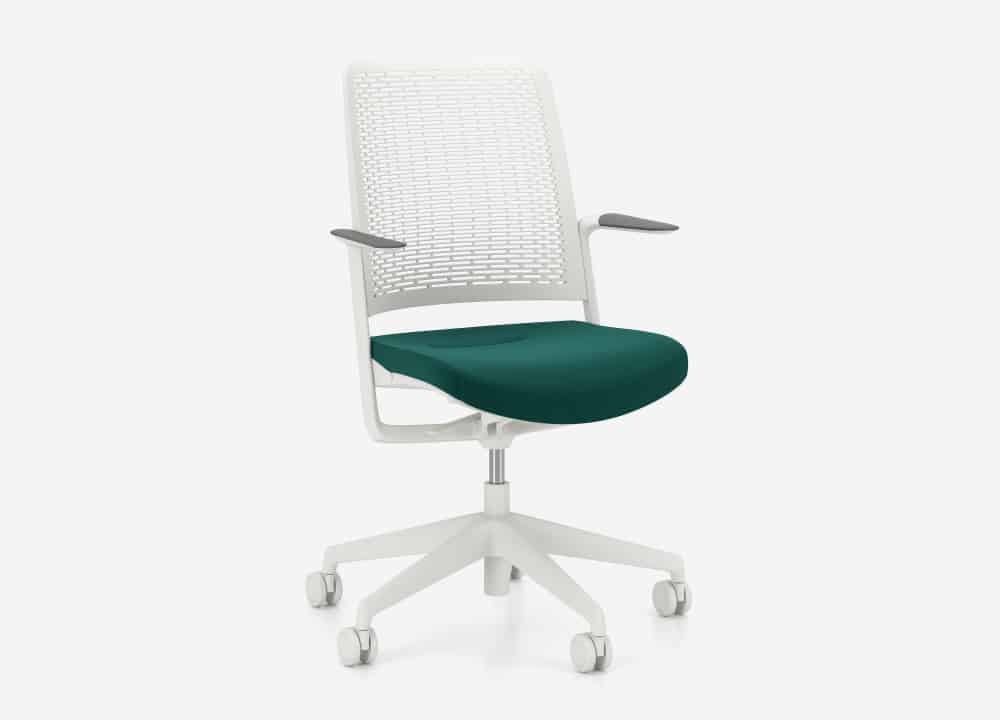
Castor wheels
One of the defining features of office chairs is that they feature castor wheels, allowing the user to easily move the chair around (e.g. pushing away from a desk).
Whilst castor wheels may seem like a relatively generic component, it’s increasingly the case that manufacturers are creating context-specific castor wheels. For example, some manufacturers allow you to choose castor wheels that are designed for either soft floors (e.g. carpets) or hard floors.
This is definitely something worth checking before you commit to a purchase!
Tip – if you want an extra element of flare, then some models are available with hollow castor wheels, which provide for a more modern look and feel to the chair.
Armrests
An armrest is just an armrest right?! Not when it comes to office chairs!
Armrests play an important part in the overall comfort and support provided by a task chair. They are especially important if you’re going to be using the chair to write all day.
When it comes to choosing an operator chair with armrests, you’ll have a number of options:
Fixed armrests
Also known as ‘loop arms’, these are basic armrests which are mounted at a fixed position on the chair. They are generally the ‘cheaper’ option and aren’t always great if you have people of different sizes using the chair.
1-D armrests
These are armrests which are only adjustable in one direction – up and down – changing the height at which they sit.
2-D armrests
These are armrests which can be adjusted in terms of their height (up and down) and width (i.e. closer or further away from you).
3-D armrests
These armrests allow you to change their height, width and the angle at which the top of the armrests themselves sit e.g. you can pivot the tops of the armrests, so they are pointing outward instead of just directly ahead in the direction of sitting.
Tip – whilst it may be tempting to spend less money and get an office chair with fixed arms, we’d strongly recommend investing in chairs that have at least some form of moveable armrest. It makes a huge difference to usability and comfort!
Weight capacity
Another important thing to consider – especially if you’re buying office chairs for a context where lots of different people will be using them – is the weight capacity of your chosen chair.
These days, the majority of office chairs (even the cheaper stock models) are designed to support larger weights. For example, a fairly ‘standard’ model such as the Jota Fabric Operator Chair can support weights of up to 150 kg (approximately 23 and a half stone).
Having said that, we’d always recommend double-checking the weight capacity of your chosen chair prior to purchase. Here at Rosehill, you’ll generally find the weight capacities of our task chairs within the product description.

Tip – in order to make your office or building as welcoming and accessible as possible, we’d recommend buying a few bariatric office chairs. These are chairs which are reinforced to support weights of 171 kg (27 stone) or more.
Office chair standards
When shopping around for office chairs it’s important to look for models which have been thoroughly tested to relevant standards.
These standards cover important factors such as the strength and durability of the furniture, its safety, fire resistance and more.
For office chairs, the types of standards you should look for include:
- BS EN 1335-1 (Office Furniture. Office Work Chair Dimensions. Determination of Dimensions).
- BS EN 1335-2 (Office Furniture. Office Work Chair Safety Requirements).
- BS 2543 (Upholstery Fabrics for End Use Applications. Classification).
- BS 5459-2 (Specification for Performance Requirements and Tests for Office Furniture).
- BS 7176 (Fire Test to Non-Domestic Seating).
- BS 5852-1 (Fire Tests for Furniture Part 1).
You’ll be able to tell if an office chair has been designed and manufactured in-line with applicable standards as it will feature things like CMHR (Combustion Modified High Resilient) foam within the seat and back pads, will be upholstered in a ‘Crib 5’ or ‘Crib 7’ fabric or material and more.
Guide – for more information, read our guide to contract furniture strength and weight testing standards.
Duration of use
How long are your office chairs likely to be used for? This may seem like an unusual question, but you’ll often find that the guarantees offered on office chairs are based on how many hours of continual use they’ll be put through each day.
For example, you will typically see task chairs advertised as being ‘8 Hour Task Chairs’. This means they’ve been designed for use in a standard office environment where the working day will last about eight hours.
Likewise, you will sometimes see task chairs advertised as being 12 hour or even 24-hour chairs. This means the chairs have been designed to be used for much longer periods of time e.g. in emergency call centres where the chairs are being used around the clock by multiple people.
Tip – it is sometimes possible to request longer guarantees on office chairs. For example, if you are looking at an eight-hour chair, but would like to know if it could be guaranteed for 12 hours use, contact us, and we can find out for you. It’s important to remember that if you’re regularly using an eight hour chair for longer periods of time, you may void the chair’s warranty.
Sustainability
An increasing number of buyers, procurement officers and other related job holders are being tasked with buying items of furniture that are environmentally friendly.
If that’s the case for you, then you’ll want to ensure you’re selecting task chairs that have suitable environmental credentials. To assess how ‘green’ an office chair is, look for:
- Whether it contains recycled materials. These can include things like recycled plastics or fabrics made from recycled materials.
- Recyclable materials. This means the chair can be more easily recycled once it comes to the end of its serviceable life.
- Replaceable parts. The more eco-friendly office chairs allow you to quickly and easily change parts once they wear out (e.g. seat pads).
- Does the chair use materials which are certified to environmental standards? For example, do they feature an eco-label?
- If the chair has plastic components, is it Greenguard certified?
Rosehill: your best source for office chairs UK
We hope you’ve found our guide to office chairs both useful and interesting! As you’ve just read, there’s a great deal to think about when choosing the best office chairs. That’s why we’re here at the end of the phone to help.
Our friendly experts are here to answer any questions and ensure you get the perfect task chair for your needs. You can reach us on 0161 485 1717 or at: sales@rosehill.co.uk.
Shop office chairs at Rosehill now
For more commercial and contract furniture buying guides, information and advice, read the Rosehill blog…
Product Spotlight: WithME Operator Chair | Conference & Meeting Room Table Buying Guide | Top 3 UK-Made Modular Seating Solutions
