


With modern churches increasingly being multi-use community spaces, and relying on the help of volunteers, it’s vital that you have chairs that are easy to move and handle. In this guide, the Rosehill team will tell you exactly what to check – from weight thresholds to dimensions – to ensure the church chairs you choose are volunteer friendly…
Why volunteer-friendly seating matters for modern UK churches
You may be wondering, “why should volunteers be at the forefront of mind when selecting church chairs?”. The answer is down to changing nature of churches, the people who attend them, and the way they are used.
Let’s take a look.
The shift from fixed pews, to individual chairs
Almost gone are the days when seating in churches was dominated by long, heavy pews.
As churches have increasingly become multi-use spaces (being used for community groups, Mums N Tots groups and others), they have shifted to adaptable seating – e.g. individual chairs that can be moved and configured into an array of seating patterns.
However, such chairs are only flexible if they can be rearranged quickly and safely – otherwise a short reconfiguration of a space becomes a heavy, time-consuming task.
Selecting church chairs with the right characteristics allows a small team of volunteers to turn a packed sanctuary into a cleared hall in minutes – keeping the building useful for the whole community.
Volunteers need protection
In most parishes, the people who set out, stack, and store seating are unpaid volunteers: PCC (Parochial Church Council) members, vergers, lunch-club helpers, and retired congregants.
These groups often include older adults who are physically vulnerable to manual-handling injuries. These injuries can include sprains, strains, and back injuries – the risk of which can increase with age.
In practice, this means that if your church chairs are heavy to lift, awkward to grip, or stack unsafely, you’re creating an avoidable health and safety problem for the very people who keep your church running.
Key point: volunteer-friendly seating isn’t just a convenience – it’s a duty of care. It’s essential that your church chairs are volunteer friendly.
Selecting volunteer-friendly church chairs: the key criteria
In this next section, we’ll cover the fundamental criteria that make church chairs ‘volunteer-friendly’. Use these criteria to assess chairs when you’re doing your research and, if necessary, speak to the Rosehill team if you need any further information.
Weight
Whilst there is no single legal “safe” weight limit for lifting in the UK, the Manual Handling Regulations require you to take a risk-based approach (rather than a fixed kilo limit).
We appreciate that is rather vague advice. So, what practical steps can you take to ensure that your chosen chairs aren’t too heavy?
- Aim for chairs that weigh as little as possible, whilst still feeling robust. Remember, each kilo saved matters when volunteers may be moving dozens of chairs at a time.
- If a chair is 10kg or heavier, treat it as potentially problematic for regular single-person lifts; if you’re not sure, ask for a sample chair and test whether an average volunteer can lift and place it comfortably.
- If your chairs are going to be moved regularly, then look for chairs that weigh no more than 8kg. Here at Rosehill, you’ll find chairs that weigh as little as 5kg.
- Choose a chair that has a matching transport trolley. This will allow your chairs to be moved and stored in bulk, rather than you having to move chairs one at a time.
The point here is that you shouldn’t necessarily choose an arbitrary weight limit – but find one that works within the broader context of your setting (e.g. how often chairs will be moved, how they will be moved, by whom they will be moved etc).
Stackability
If your place of worship is a multi-use space, then it’s almost a prerequisite that your chosen chairs are stackable. Stackability allows you to safely stow away chairs when not needed.
However, it’s important that your chosen chairs can be easily stacked by your volunteers (remember, not everyone can lift weights above certain heights).
Again, however, official guidance on safe stack height is rather vague. The HSE says that there is no ‘standard for chair stack height’. Instead, you should assess the task and follow manufacturer guidance for both stack height and compatibility.
When shopping around for stackable church chairs, you will find that they can generally be stacked 6-10 on the floor, but can be stacked much higher when stacked on a transport trolley.
Tip: for individual stack heights of chairs, check the product description. Here at Rosehill, we list the maximum safe stacking capacities of chairs. It can also be a good idea to order more than one trolley, as this can make the moving and storing of chairs much easier.
Ergonomic handling features
Other characteristics that tend to make church chairs ‘volunteer friendly’ are ergonomic handling features. Such features make the job of grasping, holding, and manipulating chairs much easier.
Examples of ergonomic handling features include:
- Handholds/top rails: certain chairs (e.g. the KI Maestro Stacking Chair) feature integrated handholds within the chair back. This makes it easier to pick up and manipulate the chair when required.
- Lightweight frame options: chairs that feature tubular frames (e.g the Vesta) can cut 1-3kg from a chair design, significantly enhancing its ergonomic credentials.
- Rounded edges: where chairs have rounded edges on their frames, seat backs and seat pads, this can reduce pinch points and eliminate harsh edges that can cut into fingers when chairs are being moved.
- Integrated linking clips: many chairs (such as the ISO), have inbuilt linking tabs. This makes it easier for volunteers to link and unlink chairs – rather than messing about with separate clips etc.
By ensuring that your chosen chairs feature at least some of these ergonomic features, you can reduce awkward postures, lower the biomechanical load on the body, and generally reduce the risk of injury amongst your volunteers.
Chair mobility aids
If there’s one thing that you can do to really make your volunteers’ lives easier, it’s to invest in a good chair trolley.
Chair trolleys (also known as chair dollies and stacking trolleys), allow volunteers to wheel stacks of chairs around your space, rather than having to carry chairs one-by-one; something that can be tiring even for the most spritely and healthy of volunteers.
It’s important to note, that these trolleys don’t tend to be ‘generic’. Many chair manufacturers will offer custom trolleys that are tailored to their exact chair models.
Tip: think about how high you’ll be stacking chairs on a trolley. Also give some thought as to how this relates to moving the trolley around your building (e.g. don’t stack chairs so high on a trolley that the trolley can’t fit through a doorway!).
Ease of assembly and out-of-the-box handling
Whilst the majority of church chairs come pre-assembled, there are a limited number that require at least a degree of self-assembly before use.
If that’s the case for your chosen church chair, make sure you check with the retailer how easy this required assembly is.
In most cases, where assembly is required, it’s little more than screwing on linking brackets or attaching the seat. Nevertheless, if you feel this would be too much for your volunteers, then choose a pre-assembled chair.
It’s also important to check how your chairs will be delivered. If you are ordering multiple chairs at once, you may find that they arrive on a pallet at the kerb side. In such instances, this would necessitate your volunteers unpacking the chairs and carrying them into the building one-by-one. If this is a concern, check with the retailer what their delivery service entails.
Note: less than 5% of our chairs require assembly. Pretty much everything we sell is ready to use ‘out of the box’.
Maintenance that respects volunteers’ time
An oft overlooked point when it comes to ensuring your chairs are ‘volunteer friendly’, is how easy they are to maintain and clean. After all, your volunteers are giving up their valuable free time; you don’t want to burden them with an excessive amount of maintenance and cleaning work.
To ensure that your furniture is easy to maintain for volunteers, consider the following:
- Specifying fabrics that are tolerant of detergent and steam.
- Avoiding fabrics that require specialist dry-clean only.
- Selecting chairs that are not upholstered, making them easy to clean and maintain.
- Specifying chairs that have easy-to-clean, well-finished metal or wooden frames.
Selecting church chairs with those characteristics will ensure your volunteers aren’t overburdened with cleaning and maintenance tasks.
Case study: providing volunteer-friendly chairs

Here at Rosehill, we were asked to do exactly what this article is about – provide volunteer-friendly chairs.
St Berteline & St Christopher’s wanted to replace tired, cumbersome seating with chairs that met three clear priorities:
- Volunteers had to be able to move and store the chairs easily.
- The congregation needed dignified, comfortable seating for services.
- The solution had to be robust enough for heavy, day-to-day use.
We began by working directly with the PCC and their volunteers to understand the real-world task: who would be setting out the chairs, how often, where they would be stacked and stored, and how many chairs needed moving on a typical week.
Rather than choosing on aesthetics alone, we used that task assessment to filter their options.
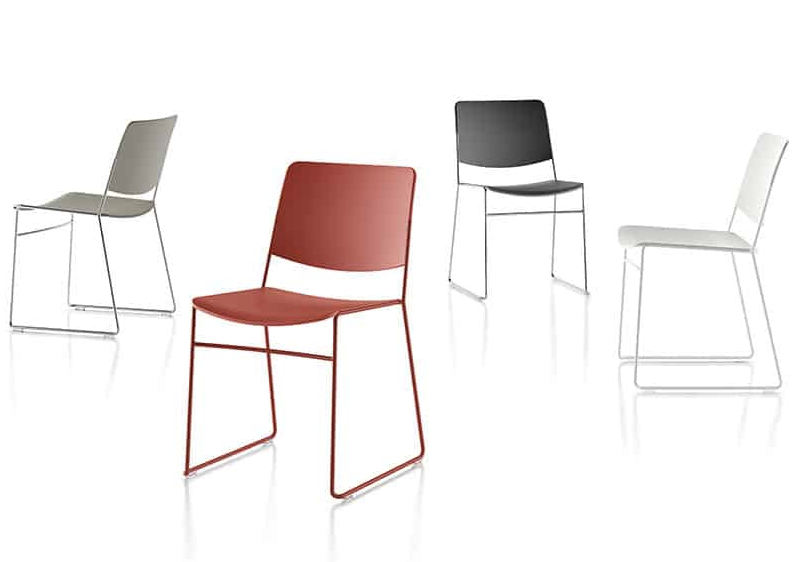
Our recommendation was the Tower 60 HD stacking chair paired with a purpose-built trolley. We chose that model because it offered the right balance of low weight, and a stable stacking geometry.
Crucially, the Tower 60 HD stacks neatly and is fully compatible with a robust chair trolley, which removes the need for repeated single-person lifts when dozens of chairs must be moved.
The outcome for St Berteline & St Christopher’s was straightforward: volunteers reported significantly less physical strain during setup, the space gained flexible, comfortable seating that suits worship and community use, and the church has confidence in a solution built to last.
The best volunteer-friendly chairs for churches
As you’ve read, there are a whole range of criteria that you need to consider to ensure your church chairs are volunteer friendly.
Well, if you’re thinking of investing in new chairs for your place of worship – then the Rosehill team has done the hard work for you. Below, you’ll find our best volunteer friendly church chairs that are lightweight, robust, and easy-to-move and maintain.
Vesta Lightweight Stacking Chair

The Vesta is Rosehill’s go-to, multipurpose seating solution for churches and other places of worship. At only 4.9kg in weight, it’s light enough that even older volunteers can lift and position individual chairs without strain.
The design stacks 10 high on the floor, and up to 20-25 high on a dedicated stacking trolley, so storage is compact, whilst moving large numbers of chairs becomes a breeze rather than a back-breaking endeavour.
The Vesta is also available with or without arms, and crucially, armchairs and armless models can be stacked together in a single stack. This provides the sort of flexibility that other stacking chairs can’t match.
To cap it all off, the Vesta comes with a 5-year guarantee, giving you additional peace of mind.
Matching table: if you’re looking for a table to go with the Vesta, check out our Lightweight Folding Table, which is available in a variety of sizes and shapes.
ISO Stacking Chair

The ISO is one of Rosehill’s best-value stacking chairs, engineered for high-use settings where budget matters, but volunteers still need furniture that’s easy to handle.
At 6.5kg it’s slightly heavier than the Vesta, but still manageable for most volunteers when handled sensibly. It’s vertical stacking geometry makes it exceptionally space efficient – the footprint of a single ISO is roughly the same as a stack, so you can store a large number of chairs in a surprisingly small area.
The ISO is available with optional arms, linking clips, and can also be upholstered in a range of bold and subtle coloured fabrics.
Matching table: the Gopak Contour is the ideal table to complement the ISO stacking chair. Easily foldable, lightweight, and trusted by churches across the land, it’s the perfect tabling solution.
Grafton HD Stacking Chair

The Grafton HD is Rosehill’s heavy-duty, low-maintenance stacking chair designed for venues that need robust, no-fuss seating and fast turnarounds. It’s British-made and engineered for high-throughput.
Up to 32 chairs can be stacked on a single trolley, so one volunteer can move an entire room’s worth of seating quickly and safely.
As it isn’t upholstered, the Grafton HD requires minimal cleaning and maintenance, whilst its perforated back provides maximum breathability during warmer times of the year.
A 15-year guarantee means you can have confidence this chair will serve your congregation reliably for years to come.
Matching table: the Grafton HD is a contemporary, stylish church chair. So, you’ll want to match it with a table that’s equally as stylish: enter the Flib – a flexible, well-designed folding table that’ll bring out the best in your space.
Make setup easier for your volunteers, with seating that lasts
Choosing the right chairs isn’t (just) a style decision – it’s a practical, safety, and cost decision. It’s a decision that Rosehill has been helping Church Councils with for years.
If you’d like to discuss your church seating requirements, then contact Rosehill’s friendly, expert team who will be happy to provide you with consultative advice and guidance.
Explore church seating at Rosehill now
For more commercial and contract furniture buying guides, information and advice, read the Rosehill blog…
Guide to Buying Church Chairs for Your Place of Worship | The Best Church Chairs with Book Boxes | What Furniture Do You Need for a Crematorium?
