


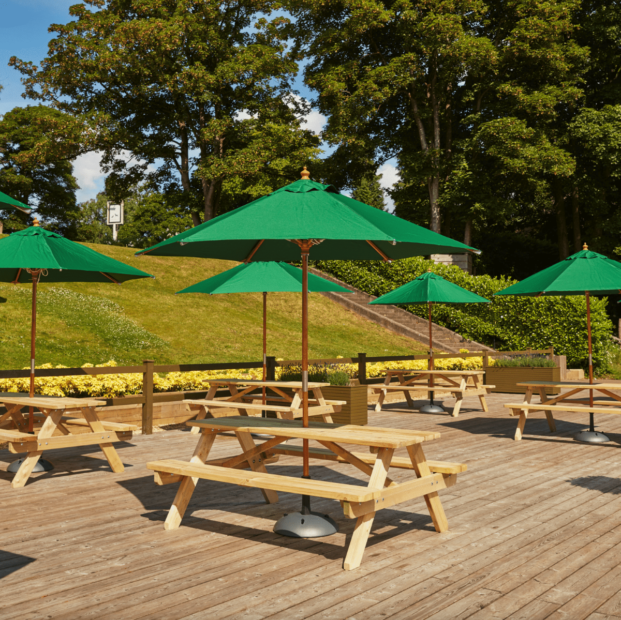
On the first genuinely warm Saturday of the year, the benches in your beer garden will fill before the bar does. People will queue for a table in the sun and walk past an empty one inside. Which is why it’s vital you have the very best picnic benches you can outside your pub, cafe or restaurant. Keep reading and Rosehill will tell you everything you need to know to buy the very best picnic benches for your hospitality space…
Why picnic benches can be a revenue asset, not a cost
Outdoor space is one of the most powerful draws in UK hospitality. And, the data backs it up.
According to research, 30% of people treat a garden or outdoor space as a deciding factor when choosing which pub/cafe/restaurant to patronise with their custom. Furthermore, some 40% of drinkers have named beer gardens as their ‘happy place’.
Think of it this way. When the sun is out, outdoor areas don’t just add a few tables – they can dramatically increase your trading capacity on exactly the days when demand peaks. That capacity is worthless though, if there’s nowhere comfortable to seat people.
Benches are what convert a patch of paving or grass into revenue generating covers.
The economics of picnic benches
It’s worth doing the maths on this opportunity. If you invest in some new benches for your pub or cafe, what can that realistically equate to in revenue terms?
Say a single six-seater bench adds six covers. On a good week, those seats might turn over twice a day – a lunch crowd and an evening one – across the warmer months of the year. At a frankly conservative £15 average spend per head, that equals:
- 6 covers x 2 turns x £15 = £180 per bench, per day.
Run that across a busy summer week and a single bench could be generating well over £1,000 in revenue for your business.
Even allowing for quieter days or an unseasonably cold/wet summer, and a picnic bench can pay for itself many times over within its first season of use.
Against numbers like that, the difference between a £160 bench and a £400 one stops looking like a cost decision and starts looking like what it is: a rounding error on the revenue the bench will generate.
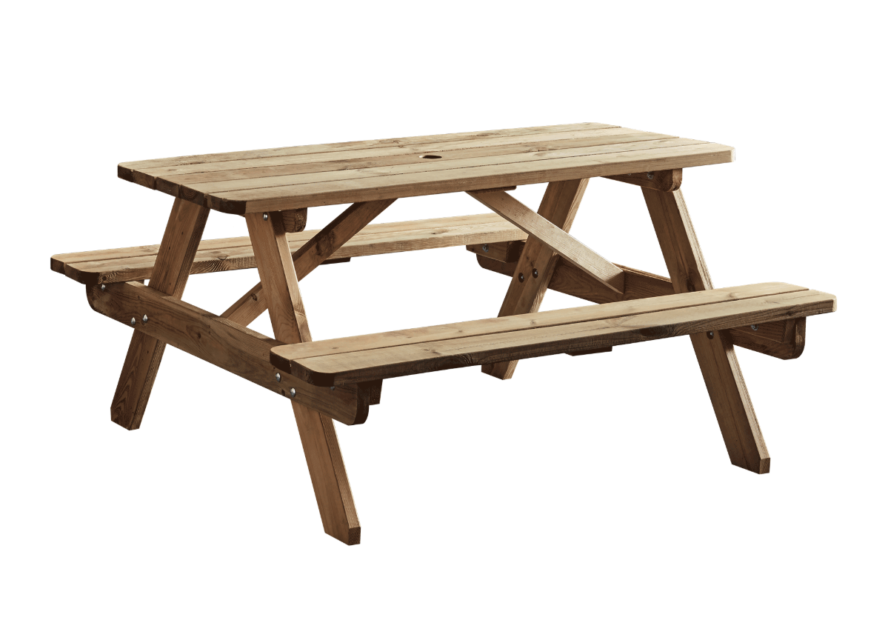
Shop Now: Hereford Picnic Bench
Why “cheap” benches cost more
Sure, you may be tempted to just pick up some really cheap benches. But, as we often say here at Rosehill, it’s a false economy.
A budget bench bought for a busy commercial setting tends to follow a predictable arc. It looks fine for a season, weathers badly through its first winter, develops splits and wobbles by year two, and gets hauled to the skip in year three.
Then you buy again – paying not just for the replacement, but for the delivery, the assembly time, and the lost covers whilst the gap in your beer garden remains empty.
A bench built for contract use breaks that cycle. It costs more on day one and far less over its lifetime – which is the calculation that actually matters – and the one we’ll come back to in detail when we look at the total cost of ownership later in this guide.
Commercial-grade versus domestic: what ‘contract’ actually means
If you take only one idea from this guide, please make it this one. The single most expensive mistake in outdoor hospitality furniture isn’t choosing the wrong material or the wrong size – it’s buying domestic-grade furniture for a commercial setting and expecting it to cope.
It won’t, and the standards governing outdoor furniture specifications spell out exactly why.
Heavy, repeated use is different from ‘the back garden’
A picnic bench at home might seat four people a handful of times across a summer. The same bench outside a pub gets sat on, climbed over, leaned back on, and shuffled around hundreds of times per week – by adults of every size, often with a few drinks in them, in all weathers, all season long.
Add the abuse that domestic furniture never sees: jet-washing every morning, tables dragged across paving to make room for a group of ten, benches left out through frost, rain, and UV from March to October without ever coming indoors.
Domestic furniture isn’t built for that kind of treatment. It’s not tested for it, either.
Put a domestic picnic bench in a beer garden and you’re not really buying furniture – you’re buying a bench that will have to be consistently replaced.
Contract-grade benches are engineered for the opposite: heavy, repeated, unsupervised use by the public, with the structural margin to survive it.
The standard to look for
If you are going to do things the proper way, then you’ll want contract-grade picnic benches that have been tested to the appropriate quality and durability standard.
UK outdoor furniture is governed by BS EN 581 – ‘Outdoor furniture. Seating and tables for camping, domestic and contract use’.
This standard tests benches at three intensity levels, and they are not interchangeable. Under the seat-fatigue test, benches are tested against the following cycles:
- Camping: 12,500 cycles.
- Domestic: 25,000 cycles.
- Contract: 50,000 cycles.
You can see that contract standard is far more demanding than the others, with contract-standard benches having to withstand four times the punishment of a camping one – the difference between surviving a few seasons and surviving a decade of public use.
Picnic bench materials compared
Shop around and you’ll find that picnic benches are available in a variety of materials. Which material is best for your particular venue is very much dependent on factors like footfall, climate, and your own appetite for maintenance (or not!).
Below, we’ve compared the main materials that are used in picnic bench construction as well as providing our recommendations for the best use case for each material type.
Softwood timber
Softwood is the classic material for outdoor pub furniture: familiar, affordable, everywhere. Almost every classic A-frame bench started life as pressure-treated redwood or pine.
The treatment matters more than the species. Pressure treatment forces preservatives deep into the wood, and properly treated softwood typically carries a 15-year anti-rot guarantee, with a real service life of 20 years or more when maintained. Cheaper ‘dip-treated’ alternatives don’t come close.
There is a catch, however. A bench in a beer garden needs re-oiling every one to two seasons, not the ‘every few years’ domestic guides suggest. Skip this important maintenance, and UV and rain will grey and open up the grain quickly.
Best for: traditional pub aesthetics, lower upfront cost, venues with maintenance capacity for annual treatment.
Hardwood timber
If softwood is the reliable regular, hardwood is the more rarely seen premium option. Iroko is the industry’s quiet favourite – rated ‘very durable’ under quality standards.
It’s naturally resistant to rot and insects thanks to its own oils. Left untreated, hardwoods like Iroko weather to an attractive silver-grey; oiled periodically, they will hold their golden-brown colour for years, even decades.
Oak is harder still, but moves and distorts more with moisture. It also requires more diligent upkeep and maintenance.
A key trade-off to keep in mind is price. Hardwood costs meaningfully more up front. For venues where the furniture is the brand, that premium buys longevity and a look that softwood can’t replicate.
Best for: premium and heritage venues, low-maintenance appetite, longer ownership horizons.
Recycled plastic
A decade ago, recycled plastic was the reluctant choice – tough, but institutional-looking. That’s all changed. It now competes on aesthetics and comprehensively wins on total cost of ownership.
Made from recycled HDPE (High-Density Polyethylene), recycled plastic doesn’t rot, splinter, fade, or need painting. A 25-year structural guarantee is now fairly standard.
Best for: high-traffic settings, minimal-maintenance appetite, coastal or exposed sites, sustainability-led procurement.
Aluminium and steel
Metal-framed picnic benches bring a sleeker, more contemporary look, and the choice between the two metals is a genuine trade-off rather than there being a clear winner.
Aluminium can’t rust – it forms a stable oxide layer instead, and powder coating adds furniture protection against corrosion and fading. It’s lighter, too, which helps with moving furniture seasonally, but hurts theft resistance.
Steel is stronger, but only lasts outdoors if it’s galvanised before powder-coating. Skip that step and it rusts through quickly.
Best for: contemporary venue branding, lightweight seasonal furniture, sheltered outdoor areas.
Concrete, stone and composites
This category of materials solves permanence, not comfort. Concrete and stone-topped tables are heavy by design – close to immovable without plant machinery – which makes them the answer to furniture drift or theft.
However, the trade-off is equally physical: they are unforgiving without cushions, expensive to install, and effectively permanent once placed.
Best for: high-theft-risk locations, permanent installations, venues where layout won’t change.
At a glance: how these materials compare
Not sure what material is right for your picnic benches? Then the handy comparison table below should help.
| Durability | Maintenance | Upfront Cost | Typical Lifespan | Theft Resistance | Sustainability | Aesthetics | |
| Softwood (Pressure-Treated) | Good, if maintained | Annual re-treatment | £ | 15-20 years | Light – needs anchoring | Moderate (FSC available) | Classic pub look |
| Hardwood (Oak/Iroko) | Excellent | Low (periodic oiling) | £££ | 20-30+ years | Moderate | Good (source-dependent) | Premium, heritage |
| Recycled Plastic | Excellent | Near zero | ££ | 25 years guaranteed | Light-moderate | Excellent | Modern, colour options |
| Aluminium | Very good | Very low | ££-£££ | 15-25 years | Light – easy to steal | Good (recyclable) | Sleek, contemporary |
| Steel (Galvanised) | Very good, if maintained | Low | ££ | 15-20 years | Heavy – theft-resistance | Moderate | Industrial, robust |
| Concrete/Stone | Excellent | Very low | £££ | 25+ years | Very heavy – theft-proof | Moderate | Utilitarian |
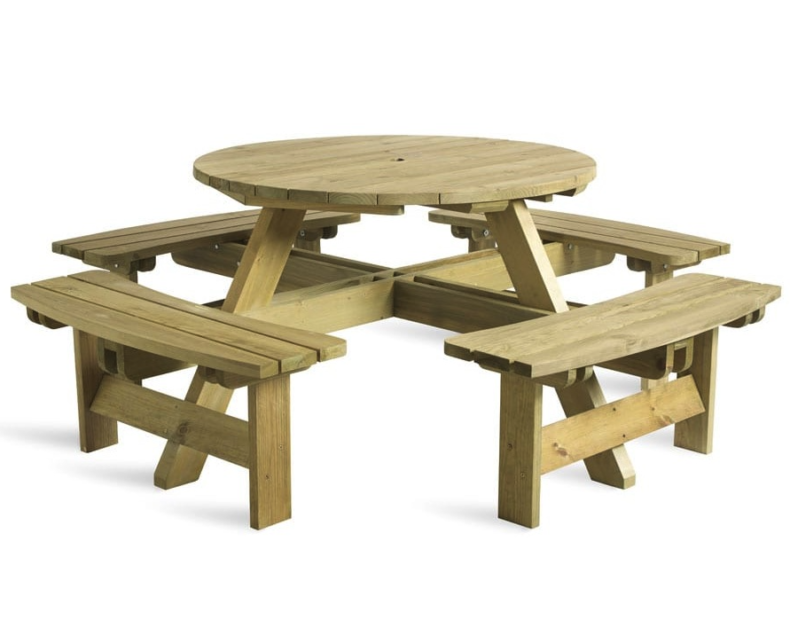
Shop Now: Round Picnic Table
Total cost of ownership: the maths that should drive your decision
This is the decision that will separate you from those who ‘take a punt’ to those hospitality owners who make considered, commercially-savvy purchasing decisions. Keep reading, and we’ll take you through the importance of the concept of ‘total cost of ownership’.
Upfront price vs whole-life cost
Here’s the trap: the sticker price is the easiest number to compare, so it’s the one most buyers stick to. It’s also the least important number in the equation.
Four cost drivers actually determine what a bench costs you over its working life:
- Purchase price: what you pay on day one.
- Treatment and upkeep: oiling, staining, jet-washing, and the labour hours behind each.
- Replacement cycles: how many times you’ll buy again before your competitor buys once.
- Downtime: lost covers whilst a broken or replaced bench sits empty.
Compare benches on the first point only, and you’re comparing a fraction of the real cost.
Example: budget dip-treated softwood vs contract-grade pressure-treated softwood
As we saw earlier, softwood picnic benches can be either ‘dip-treated’ or ‘pressure-treated’. The former is often significantly cheaper than the latter. But, as we’re about to demonstrate, this doesn’t tell the whole story.
Let’s take a closer look at each type:
- Dip-treated softwood: this is quick-dipped in preservative that only coats the surface. It’s cheaper to buy, but the preservative wears off with exposure and needs reapplying annually to stop the timber rotting from the outside in.
- Pressure-treated softwood: has preservative forced deep into the timber’s fibres under vacuum. It costs more up front, but the treatment effect lasts up to 15 years rather than one season.
Run the numbers over 15 years and the gap is stark. A dip-treated bench bought slightly cheaper needs annual re-treatment just to stand still – call it modest materials and labour each year – and still risks rot taking hold the moment upkeep slips.
A pressure-treated, contract-grade bench costs more on day one, but needs a fraction of that attention across the same period, because the protection is built into the wood rather than sitting on top of it.
Protecting your investment: notes on maintenance, security, and care
A bench that survives the weather, but ‘walks off’ in the night hasn’t saved you anything. This section covers the two threats that actually shorten a picnic bench’s working life: the elements, and other people.
Anchoring and theft prevention
Outdoor furniture theft is a remarkably common occurrence. So much so that many commercial-site furnishing suppliers treat anchoring as standard practice, not an optional extra.
An unanchored bench isn’t just a theft risk; it can shift, tip over in high winds, or simply be moved to places you don’t want it to be moved.
There are two common forms of mounting that you’ll see used in hospitality settings:
- Surface mounting: bolts drilled directly into an existing hard surface (e.g. concrete, decking, patio stone). This is the best option where a strong ground surface already exists.
- Freestanding/ground anchors: driven or augered into soil, grass, or asphalt, then attached to the bench via a cable or bracket. This is the best option when you can’t drill directly into a hard ground surface.
For higher-risk locations, a cable or chain looped through the frame and secured to a ground anchor adds a second layer of deterrence beyond the bolts themselves.
Of course, maintenance is also essential to prolonging the life of your picnic benches. Below, you’ll find an easy to follow annual maintenance calendar per material type:
| Material | Spring | Summer | Autumn | Winter |
| Pressure-treated softwood | Inspect and re-oil/stain if due | Spot-check high-wear areas | Clean before the weather turns | Check for standing water at joints |
| Hardwood (Oak/Iroko) | Light clean, oil if desired | – | Oil before winter if untreated | Minimal – natural durability does the work |
| Recycled plastic | Jet-wash or soapy water | As needed | Jet-wash | None required |
| Aluminum/Steel | Inspect coating for chips | – | Touch up any exposed metal | Check anchoring hasn’t loosened |
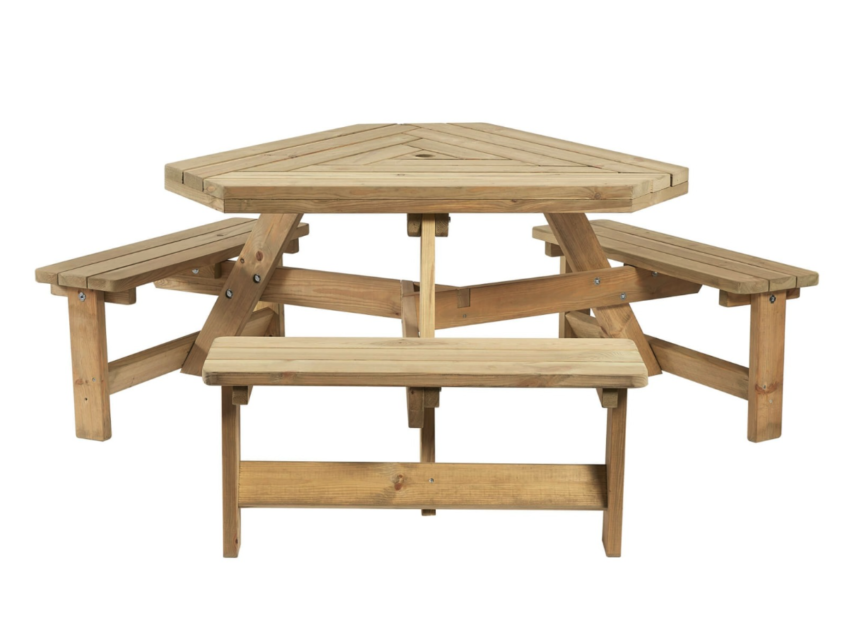
Shop Now: Triangular Picnic Table
Sustainability: the key things to know
Sustainability used to be the thing buyers would skip. But, no longer. For many buyers sustainability is now a key consideration.
If that’s you, then here are the key points to consider regarding sustainability and your picnic benches.
Recycled-content benches
Many benches – especially plastic ones – feature large amounts of recycled content in their composition. Many are typically made from HDPE (post-consumer plastic waste), diverting material that would otherwise go to landfill. For a small subset of buyers – coastal sites, local-authority tenders that specifically weigh recycled content, or venues actively building a ‘zero-waste’ brand story – this ‘circular economy’ angle can be particularly important.
Certified timber
Likewise, for timber picnic benches, sustainability can be a major consideration.
There are two major certification schemes that really matter in the UK:
- FSC (Forest Stewardship Council).
- PEFC (Programme for the Endorsement of Forest Certification).
Both work on the same principle – chain of custody – meaning every step of the supply chain, from forest to finished bench, is independently audited to confirm the timber came from a responsibly managed source.
Frequently asked questions (FAQs)
We hope you’ve found this guide useful and helpful. Although, we appreciate you may still have a few quick questions – which you’ll likely find in our frequently asked questions section below.
How long does a picnic bench last?
It depends entirely on material and specification. Pressure-treated softwood typically carries a 15-year anti-rot guarantee, with a real service life of 20 years or more when properly maintained. However, cheaper dip-treated softwood needs annual re-treatment and won’t last nearly as long.
Hardwood (e.g. Oak, Iroko), commonly lasts 20-30 years. Recycled plastic typically carries a 25-year structural guarantee.
What’s the best material for a commercial picnic bench?
For most UK pubs, cafes, and restaurants, properly specified – pressure-treated, contract-grade – softwood remains the default choice.
Hardwood suits the premium of heritage venues willing to pay more for a lower-maintenance, longer-lived version.
How do I clean and protect a wooden picnic bench?
Wash with warm soapy water and a soft brush to remove dirt before it embeds in the grain, then re-oil or re-stain roughly once a year for pressure-treated softwood (hardwood needs this less often).
Do I need a pavement licence for outdoor seating?
In England, yes, if you want to place tables, chairs or benches on the public highway (a pavement that’s part of the road network) outside your premises.
Fees tend to be capped at £500 for a new application, and £350 for a renewal (but, this is always subject to change).
Note: the process only covers removable furniture – permanent installations require permission under the Highways Act 1980 instead.
Seating entirely on your own private land doesn’t require a pavement licence at all.
This is England-only guidance; rules differ in Scotland, Wales, and Northern Ireland.
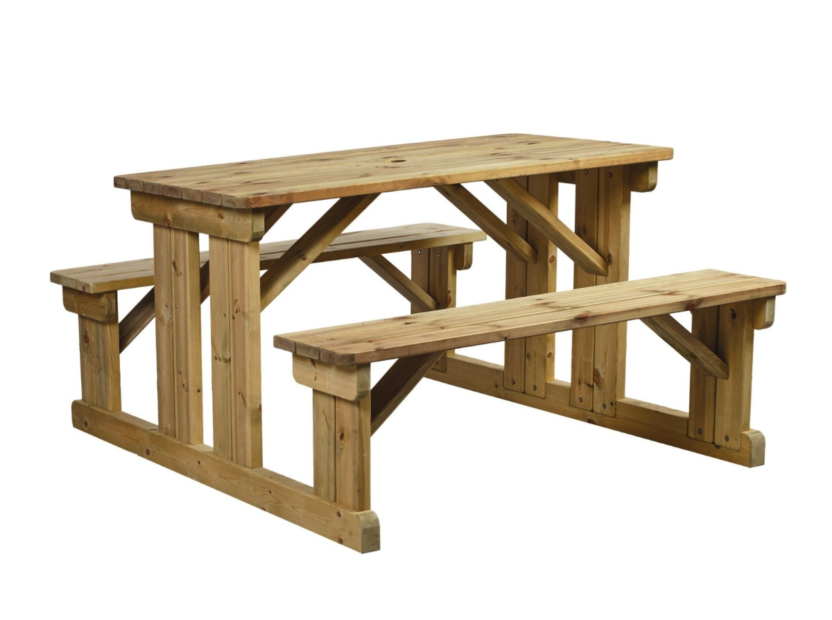
Shop Now: Walk-In Picnic Bench
Choosing the right bench for your venue
The right picnic bench for your venue isn’t the cheapest one – it’s the one specified for how hard your venue uses it. For most UK pubs, cafes, and restaurants, that means genuine contract-grade, pressure-treated softwood, bought once rather than replaced every few years.
Shop outdoor tables at Rosehill now
For more commercial and contract furniture buying guides, information and advice, read the Rosehill blog…
What Is Contract Furniture? | What Fire Safety Regulations Apply to Contract Furniture? | What Is FF&E?
